
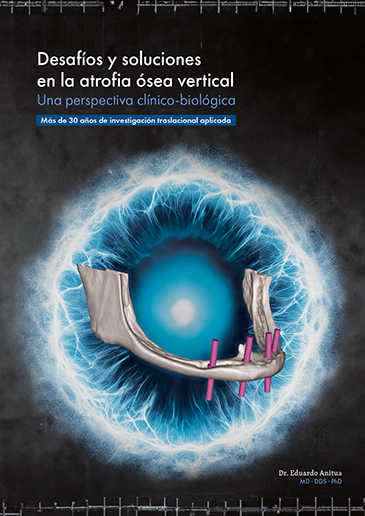
Challenges and solutions in vertical bone atrophy


Back Cover

This book offers an innovative and practical approach to treating maxillary atrophy in dental implantology, drawing on Dr Eduardo Anitua’s more than 30 years of experience. Featuring proven techniques and effective solutions, it is an essential resource for professionals seeking to enhance their skills in minimally invasive procedures and alveolar regeneration. Ideal for those who wish to provide patients with more efficient treatment and significantly improve their quality of life. An essential resource to take your practice to the next level.

160,00  VAT included

Select book language

ES EN

Idioma seleccionado: Spanish

Clear

Description

Drawing on Dr Eduardo Anitua’s decades of experience and research, this book presents an innovative and practical approach to managing maxillary atrophy in dental implantology. Anitua not only shares his most significant advances, but also the lessons learnt through the challenges he has faced, highlighting the importance of continuous learning in clinical practice.

For this reason, this work is an essential tool for professionals seeking to refine their skills and broaden their horizons in the treatment of maxillary atrophy, applying minimally invasive techniques and alveolar regeneration methods.

In short, more than a technical compendium, this book is a source of knowledge and experience that offers effective clinical solutions, designed with the aim of restoring patients’ smiles, functionality and, above all, quality of life.

Book Details

Title Challenges and solutions in vertical bone atrophy
Edition’s year 2026

1. ANATOMY OF EDENTULISM. VERTICAL ATROPHY
▪ Evolution of bone volume in the vertical direction related to edentulism
▪ Classification of vertical atrophy
▪ Anatomical determinants of vertical bone atrophy

2. SHORT AND EXTRA-SHORT IMPLANTS
▪ Evolution of implant length. From Brånemark to the present day
▪ Implants with reduced prosthetic platform

3. BIOMECHANICS OF SHORT AND EXTRA-SHORT IMPLANTS
▪ Biomechanics
▪ Biomechanics in dental implants
▪ Crown-implant ratio. Short and extra-short implants and their oral rehabilitation

4. ADAPTATION OF SURFACES TO TISSUES: BIOBLOCK® CONCEPT
▪ BIOBLOCK®

5. REHABILITATION OF THE POSTERIOR SECTOR OF THE MAXILLA WITH VERTICAL ATROPHY
▪ Tooth loss and resorption patterns in the posterior maxilla sector
▪ The maxillary sinus: development, composition and morphology
▪ Evolution of the maxillary sinus approach in the atrophic posterior maxilla
▪ Classifications of the degree of bone atrophy in the posterior maxilla
▪ Oral rehabilitation of the posterior maxillary sector by means of direct insertion of dental implants
▪ Implant placement and sinus lift
▪ Sinus lift vs. short implants for the treatment of the vertically atrophic in the posterior maxilla

6. EXTRA-SHORT IMPLANTS IN THE MAXILLA AT THE ANTERIOR LEVEL
▪ Premaxilla, growth and evolution
▪ Nasal floor elevation procedure in the management of severe vertical atrophy of the premaxilla
▪ New nasal floor elevation technique

7. EXTRA-SHORT IMPLANTS IN MANDIBULAR ATROPHY
▪ Vertical mandibular atrophy: patterns and consequences
▪ Direct insertion of short and extra-short implants in the mandible with vertical atrophy
▪ Clinical scenarios with residual height ≤5 mm
▪ Clinical scenarios with residual height ≤4 mm
▪ Clinical scenarios with residual height ≤3 mm
▪ Clinical scenarios with residual height 2 mm

8. REHABILITATION OF MODERATE-EXTREME MANDIBULAR ATROPHY IN TOTAL EDENTULISM
▪ Considerations in the fully edentulous mandible
▪ Mandible with moderate resorption and possibility of placing implants posterior to the dental foramen
▪ Fully edentulous mandible with extreme vertical resorption. Using biomechanics and prosthodontics to achieve long-term vertical bone gain

9. PROSTHESES ON SHORT IMPLANTS
▪ Importance of the prosthesis in implant-supported rehabilitation: key concepts
▪ Single-unit and multiple prostheses: fundamental characteristics and survival analysis
▪ Screw-retained prosthesis vs. cemented prosthesis
▪ Screw-retained prosthesis: components and use of transepithelial abutments
▪ Special considerations for prosthetic rehabilitation on extra-short implants (4.5 mm)

10. EPILOGUE